|
In Pluvinel's "Menaige Royal" of 1623, the proper size lance to use when jousting for rings or the quintain was 10 ft, 7 inches, much smaller than the lance used for man-to-man jousting. These lances were also equipped with a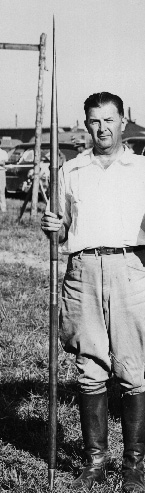 vamplate, a funnel shaped cup covering the area where the knights held the lance, protecting the hand. By the mid-eighteenth century, the American tournament rider's lance had reduced in size to about 9 feet in length. vamplate, a funnel shaped cup covering the area where the knights held the lance, protecting the hand. By the mid-eighteenth century, the American tournament rider's lance had reduced in size to about 9 feet in length.
Today there are no official specifications regulating size, weight or construction of the lance. They are as individual as the rider. Usually lances are 6 feet to 7 feet in length. Many riders have their lances custom-made to 6 feet 9 inches. The lance can then be used to measure the height of the ring from the ground when adjusting an official course.
Most lances today are constructed from wood with stainless steel or brass point and ends. Today's modern lathes can turn stainless steel into smooth, non-rusting precision points fine enough to allow even a 1/4 inch ring to slide back several inches. Many lances are also fitted with a center coupling joint so the lance can be separated and fitted into a convenient traveling box.
The weight of the lance is also a matter of individual preference. The average lance weighs about 5 to 7 pounds. Some riders prefer lightweight lances and have found that pool cues with added metal points will weigh only about 1 to 2 pounds. On the other end of the scale are the riders who prefer much heavier lances (12 to 15 pounds) to increase stability in the face of wind resistance. Arm strength and comfort levels determine the ideal weight for each individual.
|