Jousting in its original form has generally been credited to a French man named Geoffori de Pruelli. The "sport" -- actually more of an occupation at the time, spread from France to Germany, to England, and into southern Europe during the tenth to twelfth centuries. Jousting tournaments were held as military exercises between the various nobles. Such tournaments, starting peacefully often turned into bloody battles between jealous champions. Winning such tournaments was one way for a lowborn knight to make a quick name for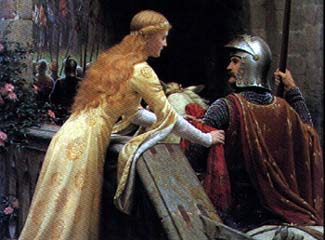 himself and win riches beyond ordinary dreams. Gradually these petty local wars became more sport oriented and sophisticated and less a matter of life or death. Knights were considered gentlemen and were required to abide by the ideas of chivalry and fair play, then in vogue. Much of the credit for this fair-play code has always gone to King Arthur and the tales of the Round Table, a thirteenth century tale. himself and win riches beyond ordinary dreams. Gradually these petty local wars became more sport oriented and sophisticated and less a matter of life or death. Knights were considered gentlemen and were required to abide by the ideas of chivalry and fair play, then in vogue. Much of the credit for this fair-play code has always gone to King Arthur and the tales of the Round Table, a thirteenth century tale.
The first accounts of "Running at the Rings" dates to the days of James I of England demonstrating a knight's extreme skill, since the rings were obviously much smaller to lance than a man. The death of several nobles and at least one king, King Henry II of France in 1559, brought about the demise of the man-to-man type of jousting. It was also during this time that gunpowder was introduced into Europe from the Orient. Guns made warfare by horse-mounted lancers obsolete overnight. Although the precise evolution of ring jousting is not known, history does provide us with many well-documented great tournaments throughout the next several centuries. Cecil Calvert, Lord Baltimore, of the "colonies" is reported to have been the first to introduce jousting here. Jousting in Europe has declined whereas Americans, on the other hand, have built interest steadily.
Let's follow the evolution of the sport.
|
|